Author: Amanda Jones

  • What Is Medicare Part D

    Medicare Part D
    Medicare Part D

    Introduction to Medicare Part D

    So many letters in the Medicare world: A, B, C, and now D! Medicare Part D refers to help with the cost of prescription drugs. It is run by private insurance companies and each plan has different prices and different formularies. No, it is not automatically covered in Original Medicare or Supplement Plans but does go along with them. It is often already covered in Advantage Plans; in fact, you cannot have an Advantage Plan with a Part D plan at the same time. (The few exceptions to this rule include some Private Fee for Service plans and Medical Savings Accounts). You may have Part A and/or Part B with a Part D on its own, but most people take a Supplement Plan and Part D together.

    What Is a Medicare Part D Formulary?

    A formulary is just a list of drugs that a private insurance company covers. They are usually ranked in tiers with lower tiers being the lowest costing drugs. In Medicare, typically Tiers 1 and 2 come with very low or no cost-sharing and do not include a deductible. Tiers 3 and above tend to include a deductible that must be paid first before the insurance company starts to pay, and the cost-sharing is higher.

    Each private insurance company typically has a team of physicians, pharmacists, and other healthcare professionals to help determine their formulary. They also decide if there are quantity or dosage limits. This formulary often changes from year to year, so be watchful to make sure your drugs will still be covered. (If you need help, call a knowledgeable broker like me to help sift through the information!)

    What If I Don’t Sign Up for Part D?

    There are some people who choose to not sign up for Medicare Part D for one reason or another. Maybe they don’t have prescriptions yet and don’t want to pay money for another plan. Maybe the extra cost is too much. Or maybe they feel like they can get a better deal on their own. Whatever the reason, if they do not sign up and do not have prescription coverage when they first turn 65, they will start to accrue a late penalty. This penalty starts to accumulate after 63 consecutive days without coverage.

    Fortunately, this penalty will not kick in until a person signs up for Part D plan later in life. Unfortunately, when you do sign up, the penalty will be applied every month and will last as long as you have a plan, even if you change insurance companies. (As of 2025, the penalty is about .40 cents for every month without coverage or $4.40 for every year without coverage).

    How Do I Avoid a Late Penalty?

    The easiest way to avoid a late penalty is to have “creditable” coverage in place. If you are covered under employer coverage past age 65, the Social Security Administration will verify that your coverage counts as creditable. Creditable means it meets the basic minimum standard allowed by Medicare. Creditable coverage avoids a late penalty. Other coverage that counts as creditable would be through the VA (Veterans Affairs) or something similar. Check with the Social Security if you are unsure if your coverage counts as creditable. Coverage on a Medicare Advantage Plan with prescription coverage counts as creditable too.

    The second way to avoid a late penalty if one is already in place is to sign up for a Low-Income Subsidy, also known as “Extra Help.” This program is run through the Social Security Administration (apply here) and is based on your income and assets. Qualifying individuals within income limits may receive help with prescription costs and eliminate their late penalty.

    Concluding Thoughts

    Don’t overlook Medicare Part D! It might seem like no big deal, but prescription costs can really rack up the medical bills quickly. Plus, no one likes to see their money wasted on penalties. Make sure you look at all of your options, find the coverage that fits you AND your budget, and get something put in place.
  • What Is a Medicare Advantage Plan?

    Advantage Plan
    Advantage Plan

    Medicare Advantage: Part C

    We’ve already talked about Original Medicare containing Medicare Parts A & B, but there is also a Part C (and a Part D) called a Medicare Advantage Plan. What is Part C? And what are the “advantages” like the name implies?

    A Medicare Advantage Plan is run by a private insurance company that takes care of your Part A and Part B coverage in one plan. Most of these plans include prescription coverage, and often they include benefits to cover dental care, vision, and hearing needs. Most importantly, these plans include an annual out-of-pocket limit to help protect your finances. If your personal Medicare costs reach that amount in a single year, the plan will take over the remaining Medicare costs for the year. So in other words, this plan like Original Medicare with bonuses. Let’s dive into the specifics.

    Top Advantages of Medicare Advantage

    There are a few strong benefits to a Medicare Advantage Plan. First is the cost savings. Premiums in an Advantage Plan tend to be much lower than a Medicare Supplement Plan. For someone on a limited fixed income, this is pretty important. Also, because dental/vision/hearing benefits are usually included within the plan, this saves money from additional insurance plans or service costs. Along with these savings is the out-of-pocket cap mentioned earlier to protect your personal finances.

    Another advantage is that in addition to dental/vision/hearing benefits, these plans often throw in other “extras” to keep you healthy. Many offer a free gym membership. Some offer rewards programs for completing healthy activities, like going in for your annual wellness visit. Some offer over-the-counter funds. These extras are intended to help you lead a healthier lifestyle and take a stronger role in your own health management.

    And finally, the other main advantage is that these Advantage Plans typically cover prescription drugs. This means that even if you have very few or no prescriptions, you can avoid the late penalty that is applied to people who skip drug coverage and then sign up later in life. If you already have drug coverage (like through the VA), there are plans you can choose from that don’t have prescription coverage and possibly save a little money.

    Disadvantages of Medicare Advantage

    Like all options in life, the Advantage option comes with some drawbacks. The first and most obvious is that you are bound to a network. You choose a Primary Care Physician (PCP) who acts within a specific network of private insurance. You don’t have the freedom to see any doctor who participates in Medicare. Some plans allow you to go outside the network if you are willing to pay a little more. Your PCP will be your go-to for regular check-ups and referrals for specialists. Fortunately, most of us are familiar with this restriction since employer health coverage tends to work in the same way.

    The second drawback to an Advantage Plan is that you are responsible for paying copays and coinsurance for your use of the plan. For someone who needs to go into the doctor a lot, this could be very burdensome. Also, even though Advantage Plans tend to save people money, the max out-of-pocket limit tends to be higher than a single year of Medicare Supplement premium payments. This means that on a healthy year you will be saving money; on a high-needs year, you may be spending more.

    The last disadvantage is the volatility of the market. Medicare Advantage Plans tend to have much more fluctuation than Supplement Plans. Each year private insurance companies evaluate changes in the market and adjust plans for the following year as needed. Sometimes changes are minimal; sometimes changes are major; and sometimes plans are even removed from the market. There are options when these things happen, but you have to keep an eye out. A trusted broker advisor (like me!) can offer valuable insights to make changes to your plan from October 15 – December 7 (aka AEP) to go into effect at the beginning of the following year.

    Summary

    Just like the Supplement side of things, Medicare Advantage has its pros and cons. There is no perfect option, but there are a lot of good ones. Hopefully this information gives you what you need to make an informed decision on how YOU want to proceed with your health coverage.

    As always, please call me to clear up any confusion you have. I’m here to help!

  • What Is a Medicare Supplement Plan?

    Supplement Plans
    Supplement Plans

    What is a Medicare Supplement Plan?

    As the name implies, a Medicare Supplement Plan supplements the benefits provided in Original Medicare. If you recall, Original Medicare is made up of Parts A and B. Part A covers inpatient benefits such as those you receive for a hospital stay. Part B covers outpatient care such as visiting a Primary Care Physician (PCP) or other specialist.

    But Original Medicare only covers 80% of your medical costs, leaving you with the remaining 20%. That’s not too bad if the bill is $100. But what happens if the bill is $25,000? Or $250,000?? That is not a stretch in today’s world. Your 20% could get exceptionally high exceptionally fast. With no cap to your expenses and no extra coverage, your risk is endless. Such a bill could easily devastate retirement savings.

    So what can you do? There are two main options to fill this “gap”. One option is the Medicare Supplement Plan. The other is the Medicare Advantage Plan. Both help put a ceiling on the maximum amount of money you will pay from your pocket. This is sometimes known as your “maximum out-of-pocket” (MOOP) amount. Today we will focus on the Supplement Plan option.

    “Medigap”: Another Name for Medicare Supplement Plans

    A Medicare Supplement Plan is also called a “Medigap” policy because it is intended to “fill the gap” that Original Medicare leaves. With a Supplement Plan, you pay a second monthly premium alongside your Part B premium. Don’t stop paying Part B! You must have Part B set up and active to enroll in a Supplement Plan. This Supplement Plan model is designed as a “pay it up front” system. It works by you paying a set fee ahead of time and then using benefits as needed. Whether you need your plan more or less in a single year, your price is the same.

    What Are the Advantages?

    There are several different types of Medicare Supplement Plan options to choose from. Each covers benefits a little differently. (Check out this handy comparison chart on the Medicare website to get a quick overview). A Medicare Supplement Plan’s advantages tend to be most beneficial for three types of people:

    • those who travel or don’t want to worry about a network
    • those who are especially concerned about their medical needs now or in the future
    • those who simply want peace of mind

    Let’s look at each of these types:

    No Network

    One of the biggest advantages of a Supplement Plan is that there is no network to deal with. If the doctor accepts Medicare, then you can see that doctor. There aren’t hoops to jump through to see a specialist. You don’t have to worry about care being covered if you change doctors (so long as they accept Medicare). And you can travel around the country with ease, knowing you can find doctors to treat you wherever you go. It takes away a lot of the stress and strife from the process.

    Medical Security

    Secondly, a Medicare Supplement Plan is well-suited for someone who presently needs or worries about needing a lot of medical care in the future. In general, a Supplement Plan has no copays or coinsurance (though fees vary by plan). You just pay your premium and Part B payments and Medicare takes care of the rest. Even if you need to see the doctor 50 times during the year, your premium payment is the same. Premium payments don’t go up based on your health claims, and you are guaranteed into a plan if you sign up when you are first eligible for Medicare (some exceptions apply). If you wait until later in life to sign up for a Supplement Plan, you will probably be asked to fill out a medical questionnaire and could be denied if you have certain conditions.

    Peace of Mind

    Lastly, a Medicare Supplement is great for people who are willing to pay a little more to have peace of mind. Because your premium payments (and keeping Part B) keep your plan active, you will know up front what your medical bills will be for the year. This makes it easier to budget with fewer surprises. Peace of mind also stems from not needing to work within a network. Plus, Supplement Plans tend to have far fewer changes from year to year compared to Advantage Plans. Also, an Advantage Plan’s maximum out-of-pocket cap (the most you would pay in one year) tends to be higher than you would pay for a year of premiums on a Supplement Plan.

    What Are the Disadvantages?

    This all sounds great, right? But what are the drawbacks? First is the cost. Some people cannot afford the cost of a Supplement Plan along with Medicare Part B when they are on a fixed retirement income. Also, as long as you are not using your plan very much, you will be paying more than the benefit you receive (unless you are counting the safety net it is for future medical needs). The next drawback is that prescriptions are not covered in a Supplement Plan and would have to be covered on a separate plan (Medicare Part D) if you don’t want to incur a fee down the road (more on that in another post). And finally, Supplement Plans tend to have few or no extra benefits like dental, vision, and hearing compared to their Advantage Plan counterparts. If you want those benefits, they will probably have to be purchased separately.

    Summary

    All in all, there are a lot of good reasons to consider a Medicare Supplement Plan when trying to plan for the future. Keep in mind all the advantages and consider the disadvantages too so you are well-informed when making a decision. Also, take a look at our Medicare Advantage post (coming up soon!) to get information on the second great option for covering that “gap.”

    As always, call us if you have questions or if something is confusing. We are happy to clear up the mess and make your decisions easier. Have a great day everybody, and make every year golden!

  • Exclusions of Original Medicare

    What Is Not Covered By Original Medicare
    What Is Not Covered By Original Medicare

    Original Medicare does not cover everything, and any medical bill you incur that is not covered will be left up to you to pay unless you have additional coverage. Here is a list (not comprehensive) of what Original Medicare does not cover:

    • Eye Exams (for prescription eyeglasses)
    • Long-term Care
    • Cosmetic Surgery
    • Massage Therapy
    • Routine Physical Exams
    • Hearing Aids (and exams for fitting them)
    • Concierge Care
    • Most Dental Care
    • Services or items from a doctor who has opted out of Medicare
    • Prescriptions not connected to inpatient care
    • Alternative Medicine

    Additionally, Medicare Part B only pays about 80% of your outpatient fees and you are responsible for the other 20% with endless financial risk. This is why it is so important that you learn about your other Medicare options (see our posts about Medicare Supplement and Medicare Advantage) and cover yourself.

  • Medicare Part B Intro

    Medicare Part B
    Medicare Part B

    What is Medicare Part B?

    Medicare Part B is the second half of Original Medicare, along with Medicare Part A. Whereas Medicare Part A covers medically necessary inpatient care, Medicare Part B covers outpatient care needed to diagnose or treat a medical condition. What does that mean in everyday terms? It generally refers to care and treatment you could receive from a doctor. It includes many preventive services such as screenings, diagnostic tests, or certain vaccines. Let’s look at some specifics.

    What Services Are Covered Under Medicare Part B?

    • Ambulance services (including life flight if it is medically necessary for your location)
    • Clinical research
    • Durable medical equipment (DME)
    • Certain outpatient prescription drugs
    • Mental health and substance abuse disorder treatment
    • Oxygen equipment and accessories

    Preventive Screenings

    Including but not limited to:

    • Bone Mass Measurements (generally once every 2 years)
    • Cardiovascular Disease Screenings (once every 5 years)
    • Colonoscopies – screenings (once every 2 years for high risk, and once every 10 years for low risk)
    • Mammograms (generally once a year after age 40)
    • Prostate Cancer Screenings (generally once a year after age 50)
    • Yearly Wellness Visits

    Durable Medical Equipment Needs

    Including but not limited to:

    • CPAP equipment
    • Hospital beds
    • Nebulizers & nebulizer medication
    • Oxygen equipment & accessories
    • Walkers, wheelchairs, and scooters

    Vaccinations

    In general, vaccinations covered by Medicare Part B come at no cost to you. These include:

    • COVID-19 Vaccine
    • Flu Vaccines
    • Hepatitis B shots under certain conditions
    • Pneumococcal shots

    Other vaccines that are recommended by the CDC’s Advisory Committee on Immunization Practices (ACIP) are included with a Medicare Part D prescription drug plan. These include shots for RSV, whooping cough, shingles, Tdap, and more. You will not have an out-of-pocket cost for these recommended vaccinations.

    Medicare Part B Limitations

    As with all Medicare, there are rules and limitations to the services provided. First, be sure that your doctor accepts Original Medicare. If you are on an Advantage Plan, you may have a network to work within. There may be copays or coinsurance that you are responsible for to receive these services. Talk to your doctor first to know what your portion will be. Typically only certain prescriptions are covered. Also consult this list at Medicare.gov to see if a particular service is covered under Original Medicare.

    In our next post we will talk about what Original Medicare does NOT cover.

  • Medicare Part A Intro

    Part A
    Medicare Part A

    Introducing Medicare Part A

    For most people who have worked within the country for at least 10 years, Medicare Part A comes at no extra cost (but yes, a deductible) when you’ve turned 65. You can sign up for Medicare Part A on the social security website at ssa.gov. Register for a new account online, choose a password, and fill in all required information. You will need to verify your identity. I recommend using the ID.me option for verification. Once you have registered for an account, you can then apply to receive Medicare Part A.

    But what does Medicare Part A cover? In general, it covers inpatient hospital costs, but it also includes Skilled Nursing Facility costs, Nursing Home Care, Home Health Services, Hospice, and services for behavioral and mental health. Let’s go into the specifics of each.

    Inpatient Hospital Care

    If your doctor gives an official order for inpatient treatment and if your hospital accepts Medicare, you may qualify for Medicare Part A benefits in the hospital (not including doctor services while there). The first 60 days have no cost after you have met your $1676 deductible (2025 rate). Days 61-90 cost $419 per day. After day 90, you begin to use what Medicare calls “reserve days.” You have a total of 60 reserve days to use over your lifetime. The coinsurance for these lifetime reserve days is $838 per day.

    It is important to remember that just because your doctor recommends something does not mean it is automatically approved by Medicare. Always ask questions to understand why certain procedures are recommended or why they are recommended more frequently. This will help you stay aware of what extra costs you may be incurring. Your provider should be able to look up what part Medicare will pay before you agree to any plan of action.

    Skilled Nursing Facility

    This is a LIMITED benefit under Medicare Part A. If you are in a skilled nursing facility (SNF) receiving rehabilitation and medical treatments after a hospital stay, Medicare will generally cover the costs for a limited time. Medicare also generally covers drugs administered to you will you are receiving care there.

    Nursing Home Care

    This is another LIMITED benefit under Medicare Part A. It specifically covers short-term skilled care to recover from an illness or injury if you meet certain conditions. It may also cover this care in your own home. It does NOT exclusively cover long-term or custodial care in these facilities. Custodial care is where you need help with usual activities of daily living (ADL) such as bathing, dressing, and eating. Again, as with the category above, make sure you ask your doctor lots of questions to verify what IS and IS NOT covered.

    Home Health Services

    These LIMITED services cover necessary medical care when you are homebound. “Homebound” is defined by Medicare as being unable to or having major difficulties leaving your home. It could also be when you are advised to NOT leave your home due to an illness or injury. Often this type of care is less expensive, more convenient, and just as effective as that in a medical center. These services could include the following: wound care, intravenous or nutrition therapy, injections, health monitoring, medical equipment for use at home, physical and occupational therapies, speech-language pathology, patient and caregiver education, and help with activities of daily living (ADLs) such as bathing, feeding, grooming, and walking that are connected to your illness or injury. You must be assessed in-person before Medicare will approve these visits. Be sure to verify with the home health agency what Medicare will cover.

    Hospice

    This type of palliative care (comfort care) is reserved for those who have been diagnosed with a terminal illness and expected to live six months or less. A regular doctor and a hospice doctor must certify the patient, and a statement must be signed confirming opting out of other Medicare-covered services. Care will be centered around being comfortable, not cured, and could be in a hospice facility, other facility, or at home. Make sure the hospice provider is Medicare-approved, and there may be some additional costs you will be responsible for. Ask (that is the common thread!) your hospice provider to help you understand what IS covered (everything necessary for end-of-life care) and what is NOT (everything NOT related to the terminal illness).

    Behavioral and Mental Health Services

    Medicare Part A covers up to 190 days of inpatient mental health care in a freestanding psychiatric hospital during your lifetime. This limitation does not apply to psychiatric care within an acute care or critical access hospital (Medicare-certified). You may also get coverage in a general hospital as an inpatient. Services may include counseling, psychotherapy, full- or part-day mental health care, and depression screenings, as well as help with opioid use disorder, smoking and tobacco use, and unhealthy drinking habits.

  • Have you ever wondered, “What is Medicare?”

    Medicare Intro 1
    Medicare Intro 1
    Medicare Intro 2
    Medicare Intro 2

    Let’s start with the basics of Medicare:

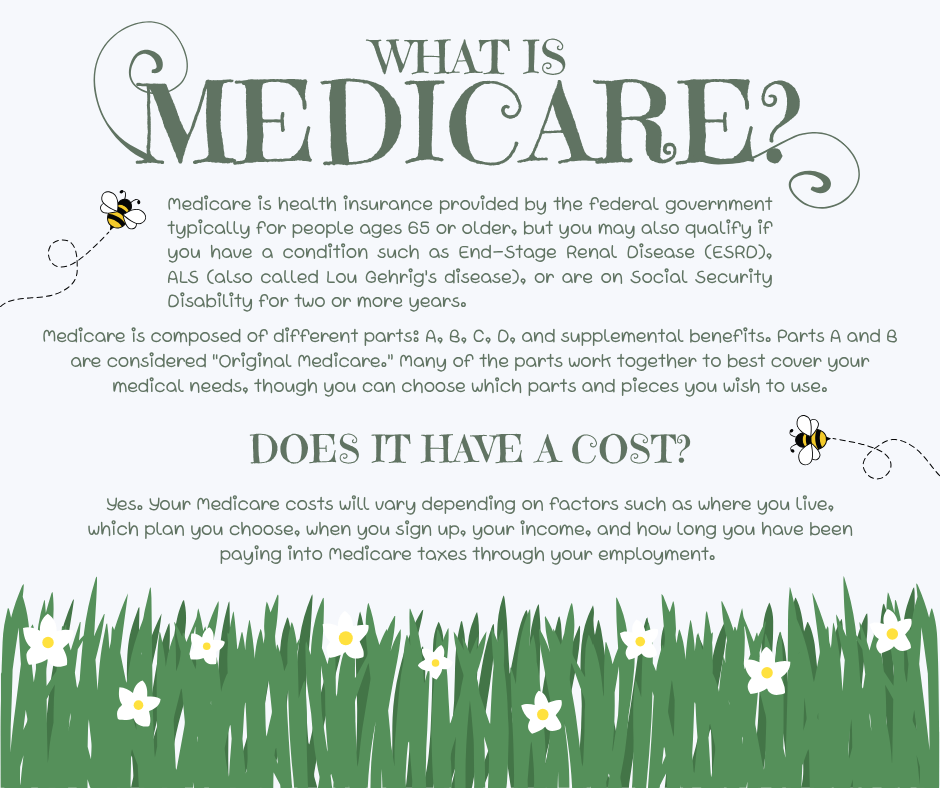
    Medicare is health insurance provided by the federal government, typically for people ages 65 or older. You may also qualify if you have a condition such as End-stage Renal Disease (ESRD), Lou Gehrig’s Disease (ALS), or are on Social Security Disability for two or more years. It is composed of different parts: A, B, C, D, and supplemental benefits. Part A and B are considered “Original Medicare.” Many of the parts work together to best cover your medical needs, though you can choose which parts and pieces you wish to use.

    • Does it have a cost? Yes. Your Medicare costs will vary depending on factors such as where you live, which plan you choose, when you sign up, your income, and how long you have been paying into Medicare taxes through your employment.
    • When do I sign up? Most people (excepting those with a qualifying condition) will sign up for Medicare anywhere from three months before your 65th birth month all the way through three months past your 65th birth month. If you sign up outside of this “Initial Enrollment Period,” you are liable to pay penalties, unless you can prove you had other creditable insurance coverage up until that point. Another benefit of signing up in this window (or shortly after employment benefits end) is you may enroll in a plan with “guaranteed issue” coverage. This means you cannot be denied for medical conditions you may have.
    A person can sign up for Medicare parts A and B through the Social Security administration either by calling the federal phone number (1-800-772-1213, though the wait times are AWFULLY long), calling a local office and setting up a one-on-one appointment, or by going online to ssa.gov and setting up a personal account.

    From there, I recommend using an agent (like me!) to discuss the myriad of supplemental options that go along with Medicare. Because I am a broker, I am able to look at options from various companies and find the best fit for you. I want your plan to meet your needs. My services are paid for by the companies that appoint me, so to you they are totally FREE! Give me a call today with your questions: 208-412-1643.

  • New Content!

    We are excited to present our new blog with all that you could ever want to know about Medicare. Stay tuned!

    Golden Years Health Plans Logo Words And Green Circle (cropped) Copy
Call (208) 412-1643